Sunday, April 10, 2011

Across the Universe, yo.


Paul McCartney, John Lennon, George Harrison, and Ringo Starr, otherwise known as The Beatles, were, and still are, one of the most influential rock bands of all time. The Beatles have influenced countless groups throughout the years, but recently, they have inspired a movie. Across the Universe, directed by Julie Taymor, is basically a Beatles musical. This movie follows an odd mix of characters all trying to survive the 1960s, throughout all of the anti-war protests, civil rights movements, and new forms of expression through rock and roll music. All of the characters are named after Beatles songs, like the main characters Jude and Lucy, and the film features some of the Beatles biggest hits, such as “Strawberry Fields Forever” and “All You Need is Love.” What makes this movie more interesting is the conflict of the Vietnam War.

The Vietnam War was an effort by the American government to try to contain communism in several Asian countries. The government installed a military draft that was used to fill the vacancies that could not be met by voluntary needs. Many young men were drafted into the military during this time period. In the movie, one of the main characters, Max, drops out of college to experience life on his own in New York City, when he is quickly drafted into the U.S. Military. In reaction to this, his sister, Lucy, begins to join the protests occurring in New York City at the time. The film really portrays the struggle to end the war in Vietnam. Another big part of the movie is drug experimentation.

During the 1960s, drug experimentation was a popular fad among the youth of America. The Beatles themselves were very interested in trying drugs, especially marijuana and LSD. This film portrays how easy it was for people to obtain drugs and use them, and the high that they got from them. The film shows Lucy and Jude going on a pyschedelic trip from LSD, while the song “Lucy in the Sky with Diamonds” is playing, a song which is an obvious drug reference. The movie shows Jude and Lucy in an alternate reality, where they float throw a sky of bright colors and mysterious figures, commonly known side effects of LSD. Overall, the film does a great job of describing life in the 1960s, as well as incorporating Beatles music in a whole new way.

Sources: http://en.wikipedia.org/wiki/The_beatles
http://www.beatle-fans.com/acrosstheuniverse.php
http://www.sonypictures.com/movies/acrosstheuniverse/site/

Pictures:http://runredhot.com/wp-content/uploads/2010/12/across-the-universe.jpg
http://upload.wikimedia.org/wikipedia/en/thumb/6/60/Across_the_universe.jpg/220px-Across_the_universe.jpg
http://4.bp.blogspot.com/-bzo61cb2lMs/TV7s2TFbfCI/AAAAAAAAAYE/flpy6WcU8Mw/s1600/across-the-universe_1.jpg

it's been a hard day's night, yo.


Most people associate John, Paul, George, and Ringo with their number one hits. However, like their idol Elvis Presley, they starred in critically acclaimed movies as well such as "A Hard Day's Night". In 1964, the Beatles hired screenwriter Alun Owen to write the script and Richard Lester to direct it. Owen wrote it from the viewpoint that the group had essentially become prisoners of their fame which was happening in real life for this movie was filmed during the height of Beatlemania; the movie in its entirety was a typical 36-hours in the lives of the "Fab Four". Later, Richard Lester would direct another Beatle movie, "Help!" and also "The Three Muskateers". Throughout the entire movie, each member of the band makes comments regarding their fame.


Although the film was produced with a low budget of $500,000 dollars, it was critically and financially successful. It was shot by United Artists in black and white over a period of 16 weeks ( filming was finished in six! ). And the movie was in theaters a mere three months after shooting commenced. Unlike most movies of the time, "A Hard Day's Night" was filmed in sequential order. The movie was originally released in the UK and when it was about to be released in the United States, the movie started some controversy. A United States executive asked Lester and the Beatles if he could dub over the Liverpool accents to make them sound Mid-Atlantic. McCartney, of the Beatles, replied out of anger if residents of England could understand Southern accents then they "could understand [them] talking Liverpool".


"A Hard Day's Night" premiered at a theatre in London on drummer Ringo Starr's 24th birthday, July 6th 1964. Critics all over the world fell in love with the movie and many praised it. Time Magazine stated that it was one of the "smoothest, freshest, funniest, films ever made. And in 2005, Time also awarded the soundtrack number four on the best soundtracks of all time. It was not only successful by critics but by the Academy as well. It was nominated for two Academy Awards for Best Screenplay and Best Score. Not only did the Beatles win over millions of teenage girls, they won over the hearts of film critics everywhere too, yo.


Sources: http://en.wikipedia.org/wiki/A_Hard_Day's_Night_(film)
http://movies.amctv.com/movie/21522/Hard-Days-Night/details

Pictures:http://blogs.forbes.com/johndragoon/2010/12/02/apple-and-the-beatles-work-it-out/
http://1linereview.blogspot.com/2010/09/hard-days-night-1964.html
http://www.filmsquish.com/guts/?q=node/4398

Lucy in the Sky with Diamonds, yo.

Paul McCartney, John Lennon, Ringo Starr, George Harrison - the Beatles. According to Encyclopedia Brittanica, the Beatles were a "British musical quartet and a global cynosure for the hopes and dreams of a generation that came of age in the 1960s." The entirety of Britain and America was in a frenzy and had a bad case of "Beatlemania". The Beatles admired many American artists: Chuck Berry, Little Richard, Fats Domino, Elvis Presley, Buddy Holly, Smokey Robinson and most importantly, Bob Dylan. Bob Dylan, American folk and rock and roll singer, has popularly been known not only for his unique singing voice, but also his drug use.During the summer of 1964, Al Aronowitz - a rock journalist, introduced the Beatles to Bob Dylan at the Hotel Delmonico in New York. Although the Beatles had tried marijuanaprior to meeting Dylan, they insisted that it had no effect on them. However, after smoking many joints with Dylan, they experienced an incredible high and were hooked.

The widespread use of illicit drugs, especially hallucinogens, was one of the major social changes that was brought about by the 1960s. Beat artists such as Bob Dylan, in an attempt to emulate the jazz musicians they admired, became heavily involved with marijuana. Beat poems, novels, essays and protest songs beginning in the mid 1950s were filled with references of hallucinogens. Lysergic acid diethylamide, known as LSD, was one of the most common drugs of the '60s that made it what it was. LSD was a chemical discovered in 1943 by Swiss chemist Albert Hofmann and although it was generally unknown in America in the '50s and early '60s, it became highly popular in the mid 1960s. In search of a new perspective on life, people also experimented with Psilocybes, also known as "Magic Mushrooms" or "Shrooms". Although Marijuana and Mushrooms had been used for thousands of years prior to the '60s, people searched for various ways to experience
these "psychedelic" drugs. The Beatles became involved in virtually all of the most popular hallucinogens during the '60s including Benzedrine, Amphetamines such as Preludin, Marijuana, LSD, Cocaine, Heroin and whatever other drugs they were introduced to at the time.

Undoubtedly, their songs were influenced by their nonstop drug use. Day in and day out, they were smoking Marijuana for breakfast, taking Amphetamines to stay awake for their concerts and taking hits of LSD for a more creative edge. Many of the members of the Beatles openly admitted to their drug use.


Some songs were even known as an "ode to pot" such as "Got to Get you into my Life" and "With a Little Help from my Friends" was known for its blantant references to getting high. "Lucy in the Sky with Diamonds" was supposedly written because John Lennon's son, Julian, came home from a school with a picture of his friend, Lucy O'Donnell, with stars in the sky. Julian Lennon called the picture "Lucy in the Sky with Diamonds" and John Lennon says that this was the reason he wrote the song. If the title of the song is more carefully analyzed however, it spells out LSD. Lennon said during a 1975 interview that he never payed attention to what the song title spelled out and after the criticism the Beatles received for this song, he payed close attention to the song titles but they never spelled anything.


You can see from the video above that the song is normally represented as very psychedelic and shows hallucinations. It is hard to believe that

Pictures:
http://www.last.fm/music/The+Beatles/+images/5662457
http://www.layoutsparks.com/myspace-layouts/lsd_0
http://connect.in.com/julian-lennon/photos-1-1-1-ef94ed23320b2d4c55f14a04a33f56d3.html
http://www.dailymail.co.uk/news/article-1216660/Lucy-In-The-Sky-With-Diamonds-Lucy-ODonnell-inspiration-dies-battling-disease.html

Information:
http://www2.lib.virginia.edu/exhibits/sixties/drugs.html
http://www.d.umn.edu/cla/faculty/tbacig/cst3010/drugs.html
http://www.songfacts.com/detail.php?id=120
http://www.beatlesbible.com/feaxtures/drugs/

Sunday, April 3, 2011

Race Records? Soooo outdated, yo.


Race records - 78 rpm phonograph records geared towards and produced by African Americans. Initially coined "race records" by the Chicago Defender in 1922, the term quickly spread. In the 1920s, records were largely popular due to the Great Migration. Around 1916, Southern African Americans began their migration to the Northern states. Southern migrants yearned for the music they were used to in the South. Record companies such as Okeh, Paramount, Vocalion and Columbia quickly became involved in the production of these so called "race records" because of their increasing popularity.

The first popular race record? It's hard to say, but the 1920 recording of Mamie Smith's "Crazy Blues" under Okeh Records or Bessie Smith's "Down Hearted Blues" under Columbia Records are good contestants. Race records only became increasingly popular, appealing to African Americans and many white teenagers. While many were searching for white singers to sing "race music", African Americans were eager to buy music recorded by their own race. For the most part, white recording companies dominated race records until black owned record companies such as Black Swan and Black Patti surfaced.

Black Swan records, established by Harry Pace, boasted that they were "The Only Genuine Colored Records - Others Are Only Passing For Colored." African Americans were not satisfied with
their style of music redone by white artists and therefore, race records were marketed directly toward an African American audience. Race records quickly expanded beyond Jazz and Blues to include gospel music, sermons, jug-and-washboard bands, string bands, spirituals and even comedy routines. Although white record producers realized the appeal of this so-called "race music", white artists felt as though it was inappropriate for all audiences and that it was best for them to stick to the "blues and stomp numbers" that came to them naturally.

Although the record industry was booming, the Stock Market Crash of 1929 caused the Great Depression, putting the so-called "Jazz Age" to an end. In the 1920s, record sales were up to a 100 million a year, but after the Great Depression it dropped to a measly 6 million per year. Many of the record companies who had previously produced race records went out of business. Record companies were unable to prosper again until the mid 1930s and by then no one wanted the hear the blues anymore. It wasn't until after the end of World War II when the record industry had its next major growth period. By then, small jazz and hillbilly music became popular and race music transformed into Rhythm and Blues. By the 50s, race records became almost useless and unnecessary.

Race records were a huge part of the early 20th century, but after the Great Depression, everything changed. African American artists were ecstatic that they were able to share their music with many different audiences, despite the struggle against white artists attempting to reproduce their style of music. It was often the case that African American artists were misinformed about the amount of record sales, the copyright laws that could have protected their music and they were often underpaid or denied the wages that they had earned from their recordings. Although this was unfair, some of the black-owned record companies changed these policies. Despite these struggles, African Americans displayed so much pride in their music.

Pictures:
http://jasobrecht.com/mamie-smith-the-first-lady-of-the-blues/
http://www.gracyk.com/assess.shtml
http://www.mainspringpress.com/blues_BScover.html
http://wikihistoria.wikispaces.com/Jazz+Age
https://jazzlives.wordpress.com/tag/victor-records/

Information:
http://www.pbs.org/jazz/exchange/exchange_race_records.htm
http://en.wikipedia.org/wiki/Race_record
http://www.centerstage.org/marainey/Digital-Dramaturgy/The-Blues/Race-Records.aspx
...and all of the websites associated with the links.

rock n' roll took over teenagers, yo.

When Rock n' Roll was brought into this time period parents immediately started seeing change in their children, and believed it was setting a bad example on them. The people singing the music and the lyrics its self had a huge impact on teens. Three singers of the 50's were Elvis Presley, Little Richard, and Buddy Holly.

Elvis Presley had by far the greatest impact on Rock n' Roll in the fifties. He was known for his great performances and making teenage girls woo over him. He was extremely attractive and talented, which is just what parents didn't want around their daughters. According to Rolling Stones Magazine, "it was Elvis who made rock n' roll the international language of pop".

Little Richard was known as the inventor of Rock n' Roll. He was known for his wild performances, and ridiculous behavior, which only made teenager even more drawn to him then they already were.

Buddy Holly was a song writer, and instrumentalist who was a big star during the 1950's with his music.

Another effect on teens during the 50's was television. Since it wasn't a very popular thing, not many people had a tv, and when they did, children spent most of their time watching it. One big show was American Band Stand. This show was hosted by Dick Clark and started a career for multiple big time stars. It was an afternoon tv show that kids could come home after school and watch with friends, it was a big deal to all of the teenagers. Parents thought that all of this Rock n' Roll was creating bad behavior with their teenagers, and started drugs, alcohol, sex, and everything parents don't want for their children.


BLOG:
http://www.kidsnewsroom.org/elmer/infoCentral/frameset/decade/1950.htm
http://www.empire.k12.ca.us/capistrano/Mike/capmusic/modern/rock%20'n%20roll/rock'n.htm
PICTURES:
http://ecx.images-amazon.com/images/I/41XQ3C1Z0FL._SL500_AA300_.jpg
http://symonsez.files.wordpress.com/2010/06/elvis-presley.jpg
http://www.boomernet.com/assets/images/little_richard.jpg

Duck and Cover, yo.


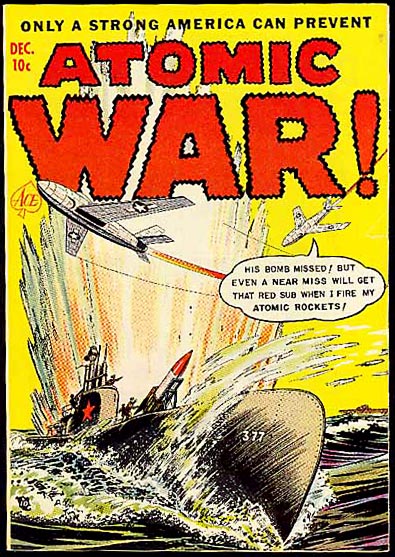
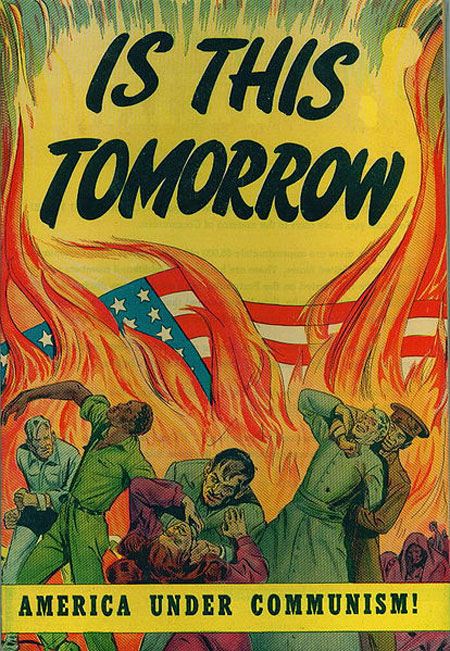
Duck and Cover became a popular phrase in America during the Cold War. As the war progressed, the American government's use of propaganda skyrocketed. Propaganda was used everywhere from military support to the dangers of the atomic bomb. Communism was an ever present threat to American society during the Cold War. American citizens were warned almost everyday about the fact that the Soviets could bomb them at any second. As demonstrated in the video, Bert the Turtle, along with the others, were told to "duck and cover" in order to avoid the dangers of the atomic bomb. Although this would not protect anyone from an atomic attack, it gave many Americans a sense of comfort throughout this difficult time. Protection against the atomic bomb was not the only thing propaganda was used for, however.

The American government also used propaganda to stop the spread of communism. Stopping communism, or "containment," was the government's main focal point throughout the Cold War. Film, radio, and television were used to show the dangers of a communist society. The American Government tried to depict communist governments, mostly the Soviet Union, as dictatorships that brainwashed their citizens. Communist citizens were portrayed as robots who only functioned for the good of their country, while Communist leaders were portrayed as dictators whose main goal was to restrict the freedoms of their citizens. These depictions were used to show an American, capitalist way of life was the only form that was acceptable.

The American government was also using propaganda to encourage military involvement. Even though there was a military draft at this time, the government was still actively trying to get men excited about joining the military. Many films were made to encourage young men to seriously consider the military as a career. This was an effective method for young men, especially men of lower classes that did not have much of a future ahead of them. Propaganda became such a big part of American society that Eisenhower created an independent agency called the United States Information Agency. The USIA was in charge of the millions of dollars that was put into pyschological warfare and propaganda throughout the rest of the Cold War.


Sources: http://www.americanforeignrelations.com/O-W/Propaganda-Cold-war.html
http://en.wikipedia.org/wiki/Propaganda#Cold_War_propaganda
http://en.wikipedia.org/wiki/USIA

Pictures: http://www.designer-daily.com/wp-content/uploads/2009/08/america-under-communism.jpg
http://www.loc.gov/rr/print/guide/pp0594.jpg
http://www.esquirecomics.com/resources/collection_images/AtomicWar2.jpg

Video: http://www.youtube.com/watch?v=IKqXu-5jw60

Dalton Trumbo beats the Blacklist, yo.


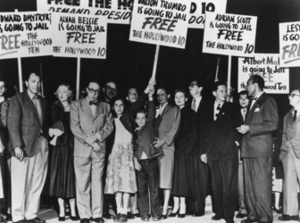
It all began in 1938 when Martin Dies Jr, claimed that communisum was prevalent in Hollywood. The blacklisting started when forty three actors, directors, screen writers, and producers were alleged to be part of the Communist Party. However, out of the forty three people put on that list, nineteen refused to give evidence. They claimed that this was against their first amendment right to freedom of speech and assembly. In addition to the blacklist, Eric Johnson, president of the Motion Picture Association of America, issued a statement known as the "Waldorf Statement" which declared that the ten witnesses would be fired and suspended from acting until their charges were clear and had sworn they were,in fact, not Communists. Although this statement seemed unbreakable, one person outsmarted it, and his name was Dalton Trumbo.

Dalton Trumbo was born in Colorado in 1905. He originally started his career as an editor, writer, and critic for a magazine called the "Hollywood Spectator". He eventually landed a deal as a junior writer for Warner Brothers and started writing movies in 1937 and three years later, he was one of the highest paid writers in Hollywood. His most popular movies include, "Our Vines Have Tender Grapes", and "Kitty Foyle". Although he was very successful in movies, he went back to writing in 1939 and wrote an anti-war novel titled "Johnny Got his Gun". Throughout World War II, Trumbo received letters from Americans using this book to support their argument to make peace with the nazi's in Germany. Naively and foolishly, he reported these letters to the FBI. One afternoon they showed up at his doorstep and he had an epiphany. He realized that the FBI's interest was not in what was written in the letters but in himself. He eventually spent 11 months in a Kentucky prison.

Even after his sentence, Trumbo was not shaken by the U.S. government; he wrote thirty scripts under various pseudonyms. Later, Trumbo was credited for writing screenplays for successful movies such as "Exodus", "Sparticus", "The Brave One", and "Roman Holiday" which featured Academy Award Winner, Audrey Hepburn. In 1956, "The Brave One" was awarded an Oscar under one of his pseodonym's Robert Rich. Also, Ian McLellan Hunter, won an Oscar as a front for Trumbo, for "Roman Holiday" in 1953. Years later, in 1975 and 1993, the Academy publicly recognized Trumbo for his success. And ironically, the film was preserved in the US Film Registry by the Library of Congress. Although other members of the blacklist stopped working altogether, Dalton Trumbo proved that he could do whatever he wanted to do.


Sources: http://en.wikipedia.org/wiki/Hollywood_blacklist
http://en.wikipedia.org/wiki/Roman_Holiday
http://www.imdb.com/name/nm0874308/bio
http://www.mcpld.org/trumbo/WebPages/biography.htm
http://www.britannica.com/EBchecked/topic/607210/Dalton-Trumbo

Pictures: http://www.rottentomatoes.com/celebrity/dalton_trumbo/pictures/9731225.php?type=flixster
http://www.mcpld.org/trumbo/WebPages/photogallery.htm
http://www.spartacus.schoolnet.co.uk/USAredC.htm
http://www.listal.com/viewimage/36155

Friday, March 25, 2011

The King moves into Film and TV, yo.


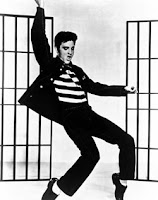
Before the Beatles made their famous debut on "The Ed Sullivan Show", Elvis Presley's appearance was the one that girls were screeching over. He performed on Sullivan's show three times each time being more memorable and scandalous then the next. On his third and final time on Sullivan's show, he was shown only from the waist up due to his notable hip gyrations seen on the picture to the left. This objection was due to the host and creator of the show, Ed Sullivan. He told TV Guide that " as for his gyrations, the whole thing can be controlled with camera shots." Elvis Presley would go down in history, making his appearance one of early television's most unforgettable moments. Just as LadyGaga is "doing it for the fame" Elvis and many other artists of his day were doing the same thing; Elvis desperately wanted to become an actor.

Although Elvis is generally known for his success as a singer, he was quite successful in film totaling 31 movies throughout his career as an actor. Despite the lack of plot in his movies, the
ratings were extremely high. His most popular and critically acclaimed films include "Jailhouse Rock" and "King Creole". Coinciding with the premiere of "Jailhouse Rock", a song of the same title was released on September 24, 1957. It immediately went to number one on the Billboard EP charts and stayed there for 7 weeks. It also landed # 67 on Rolling Stones magazine list of 500 Greatest Songs of all time.

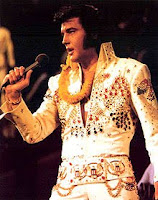
Unlike other singers who try to find success in movies, Elvis's career as an actor did not end on the movie screen, however. In addition to his roles in numerous movies, Elvis played himself and his hit songs in three network television specials: "Elvis", "Elvis: Aloha from Hawaii via satellite" and "Elvis in Concert". Each one of these were memorable and they were all critically acclaimed. "Elvis: Aloha from Hawaii via satellite" was especially highly rated and it was seen in 40 countries which was unheard of at the time; it was more notably remembered for being watched in more homes than the first man on the moon! For most people, Elvis Presley is remembered for his signature white jumpsuit. He, in fact, first wore it in "Elvis:Aloha from Hawaii via satellite". Elvis performed a large spectrum of old and new songs such as "Burning Love" and his cover of Carl Perkins' "Blue Suede Shoes".

Elvis Presley's talent and looks won over millions of people helping him sell over one million records and obtaining three Grammy wins, one of which being the Lifetime Achievement Award. Elvis "The King" Presley will never be forgotten, yo.

sources: http://www.elvis.com/
http://en.wikipedia.org/wiki/Elvis_Presley

pictures: http://www.elvispresleymusic.com.au/pictures/1956_1957_elvis_ed_sullivan_show.html
http://blogs.kansascity.com/crime_scene/2007/08/then-one-night-.html
http://en.wikipedia.org/wiki/Jailhouse_Rock_(film)
http://www.personal.psu.edu/users/e/q/eqn5010/Assignment%205-6.htm